Stop Waiting for the Perfect Desk: What Vietnamese Students Know About Learning Anywhere
There is a peculiar ritual that plays out in dormitories and suburban bedrooms across the United States every fall semester. Students spend hours — sometimes entire weekends — arranging their study spaces. Monitors are repositioned. Ambient lighting is calibrated. Noise-canceling headphones are charged. Desk plants are watered and placed just so. And yet, despite all this careful preparation, the studying itself often never quite begins.
This is not laziness. It is, in many ways, a culturally learned behavior. American educational culture has absorbed a powerful narrative: that the right environment is a prerequisite for serious intellectual work. Productivity influencers, university wellness guides, and even well-meaning teachers have reinforced the idea that focus is something you construct externally before you can access it internally.
Vietnamese educational tradition holds a fundamentally different view — and it is one that deserves serious consideration by students navigating the very real pressures of academic life in the US today.
Learning in the Margins
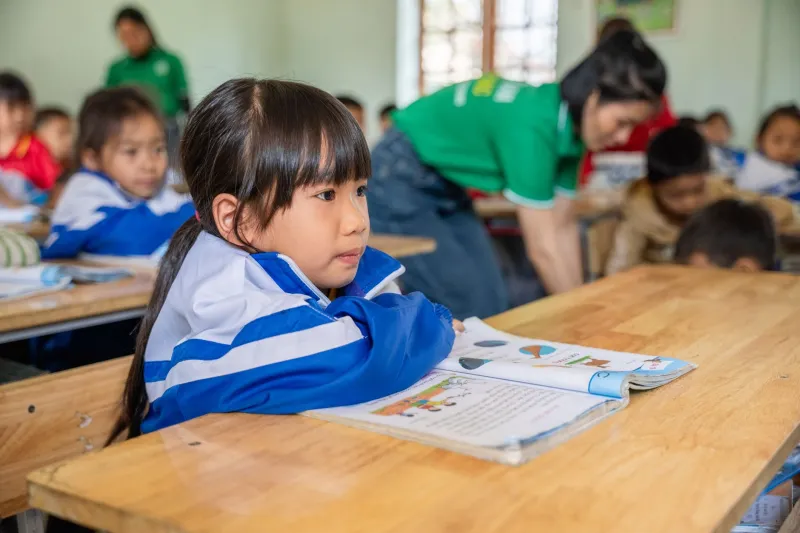
In Vietnam, particularly among older generations and rural communities, the image of a student bent over a textbook by lamplight in a crowded household is not a symbol of hardship to be overcome. It is, in many families, simply Tuesday evening. Children have historically studied on kitchen tables shared with siblings, in small apartments where noise is a constant companion, and during commutes on motorbikes and public buses.
This is not romanticized poverty. It is evidence of a deeply pragmatic relationship with learning — one that locates the act of studying inside the student rather than inside the room.
The Vietnamese concept of chịu khó — roughly translated as the willingness to endure difficulty without complaint — is woven into how many Vietnamese families talk about education. It is not about suffering for its own sake. Rather, it reflects a belief that the capacity to concentrate, to persist, and to absorb knowledge is a skill that must be practiced under varying conditions, not a fragile state that must be protected from disturbance.
The Optimization Trap
Research in cognitive psychology does support the idea that certain environmental factors — excessive noise, poor lighting, high temperatures — can impair concentration. No one is arguing that a jackhammer outside your window is irrelevant to your reading comprehension.
But there is a meaningful difference between managing genuine obstacles and using imperfect conditions as a reason to delay engagement with difficult material. The latter is a form of procrastination dressed up as preparation.
Psychologists refer to this as "task aversion" — the tendency to avoid activities that feel cognitively demanding by substituting preparatory rituals that feel productive but are not. Rearranging your desk is far more immediately satisfying than wrestling with a challenging chapter. The brain, given the choice, will often choose the former and rationalize it as the latter.
The Vietnamese student who has learned to open a book on a noisy bus has, without necessarily knowing the terminology, trained themselves out of this trap. They have internalized a simple but powerful truth: the conditions will rarely be ideal, and waiting for ideal conditions is a form of not studying.
Building Attention From the Inside Out
So how does one actually develop the kind of adaptable focus that thrives in imperfect settings? The answer lies less in environmental design and more in deliberate mental conditioning.
Start before you are ready. One of the most effective habits a student can build is the practice of beginning work even when the environment feels suboptimal. This is not masochism — it is training. The brain's ability to filter distractions improves with consistent practice, much like a muscle. Students who always wait for silence become students who cannot work without it.
Vary your study locations intentionally. Research from cognitive science, including work by Robert Bjork at UCLA, suggests that studying the same material in multiple different environments can actually enhance long-term retention. The brain forms richer memory traces when it associates information with varied contexts. The student who studies at home, at the library, at a coffee shop, and yes, occasionally in a noisy common room, may retain material more robustly than the one who only works at their carefully curated desk.
Separate the ritual from the work. There is nothing wrong with having a cup of tea before you study or putting on a particular playlist to signal to your brain that it is time to focus. Rituals can be genuinely useful anchors. The problem arises when the ritual becomes the point — when making the tea takes forty-five minutes and the studying never starts. Keep the ritual brief and let it serve the work, not replace it.
Practice tolerating discomfort. This is, admittedly, easier said than done. But students who can sit with mild discomfort — a slightly too-warm room, background conversation, a chair that is not quite right — without immediately seeking to eliminate it are developing a form of psychological resilience that will serve them far beyond any single exam.
What American Students Can Borrow
This is not a call to abandon ergonomic chairs or to study exclusively in chaos. The point is not that discomfort is inherently educational. The point is that the tolerance of imperfect conditions is itself a learnable skill — and one that many American students are inadvertently depriving themselves of by treating environmental perfection as a prerequisite rather than a luxury.
Vietnamese students who have immigrated to the US and gone on to succeed in demanding academic programs often describe a certain bewilderment at the amount of time their peers spend preparing to study rather than studying. This is not a cultural superiority claim. It is an observation about what happens when adaptability is treated as a core competency rather than a consolation prize for people who cannot afford better.
The deeper lesson from Vietnamese educational philosophy is this: the student who can learn anywhere has built something more durable than a beautiful study space. They have built a mind that does not require permission from its surroundings to do its work.
A Final Word
If your desk is tidy and your lighting is warm and your environment genuinely supports your focus, that is wonderful. Use it. But if you find yourself perpetually waiting for those conditions before you begin — if the perfect study session is always one more adjustment away — it may be worth asking whether the obstacle is really the room, or whether it is something you are carrying inside it.
The students who learn to answer that question honestly tend to be the ones who keep learning long after the ideal conditions fail to arrive.