Reading Your Syllabus Like a Map Instead of a Sentence
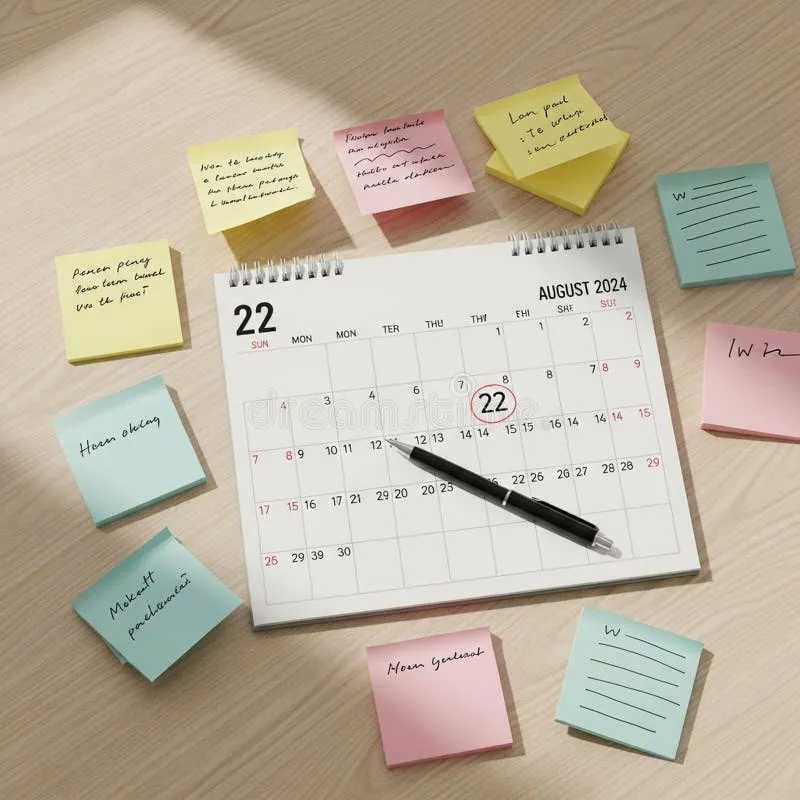
Photo: semester wall calendar with colorful handwritten notes and highlighters on desk, via thumbs.dreamstime.com
Somewhere in the first week of the semester, an instructor hands you a document that most students glance at, file away, and never open again until the night before the final. This is a strange habit when you consider what the syllabus actually is: a complete map of the next four months, drawn in advance, freely given.
Part of the problem is how we were taught to read it. In American school culture, the syllabus often arrives framed as a contract of consequences — here is what happens if you miss class, here is the late policy, here is the grading scale. Read this way, the syllabus is a set of traps to avoid. But there is an older and more useful way to see it, one that resonates with how Vietnamese families have long approached planning: look far ahead, prepare the ground early, and leave room for rest so the harvest is not ruined by exhaustion.
The Map-Reading Exercise
Set aside forty-five minutes in the first week of term. You will need your syllabi, a calendar (paper works best for this), and three colors of pen or highlighter.
Step one: mark every fixed commitment. Go through each syllabus and transfer every exam, paper deadline, presentation, and major lab onto the calendar. Do not judge them yet; just get them on the map. Then step back and look for what planners call crunch weeks — the stretches where two or more deadlines collide. Most semesters have two or three, and they are rarely where students expect them. Mid-October and the week before Thanksgiving break are common danger zones.
Step two: schedule the recovery before you need it. Here is where most semester plans fail. Students map the work and forget the rest. Look at your calendar and deliberately mark light weeks — stretches after a crunch period where you will deliberately do less. Block an evening off. Protect a Sunday. This is not laziness; it is the agricultural logic of crop rotation. Fields left fallow produce more over time, and so do students.
Step three: write one personal goal per course that grades cannot capture. Underneath each course title, add a sentence like: "By December, I want to be able to explain the central argument of this field to my roommate in five minutes," or "I want to actually enjoy one of the readings, not just summarize it." These are your learning goals, as distinct from your performance goals. Decades of research on achievement motivation — much of it built on the work of psychologists like Carol Dweck — suggest that students oriented toward genuine mastery recover from setbacks better than those oriented purely toward scores.
The Long View
There is a proverb often told in Vietnamese households: kế hoạch dài hạn bắt đầu từ một bước nhỏ — a long journey begins with a small step. A syllabus mapped in week one is exactly that: a small act of foresight that pays dividends for months. Students who do this exercise report something unexpected by midterms. Because they saw the crunch coming, they were never surprised by it. Surprise, more than workload itself, is what turns a hard week into a crisis.
The map also gives you permission. When a friend invites you to something during a deliberately light week, you can say yes without guilt, because you know what is coming in the week after. Sustainability is not about doing less overall; it is about doing the right things at the right times.
A Closing Thought
The word học in Vietnamese means both to study and to learn, and it carries with it the sense of an ongoing practice rather than a series of graded events. Your professors, whatever their intentions, have handed you the outline of that practice. Treat the syllabus as a gift of foresight rather than a list of threats, and the semester stops being something that happens to you — and becomes something you helped design.