What Vietnamese Temple Halls Know About Focus That Your Dorm Room Doesn't
The Room That Teaches Before You Open a Book
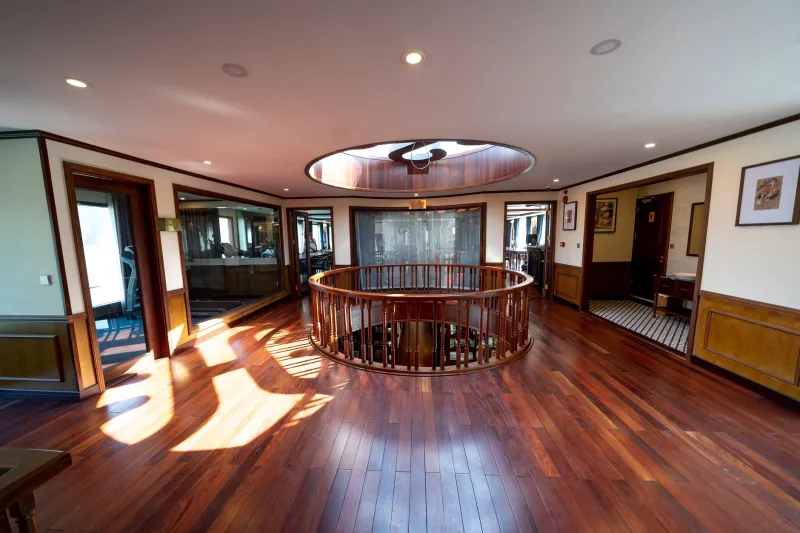
Walk into a traditional Vietnamese monastery study hall and you will notice, almost immediately, what is not there. There are no stacks of half-read paperbacks competing for your attention. There are no notification badges glowing from a laptop screen propped open beside a cold cup of coffee. There is, instead, a quality of stillness that feels almost structural—as if the walls themselves were engineered to slow the mind down.
This is not accidental. In Vietnamese Buddhist and Confucian learning traditions, the physical environment has long been regarded as a co-instructor. The arrangement of furniture, the ratio of open floor to occupied space, the deliberate absence of decorative distraction—each of these choices reflects a foundational belief: that the mind cannot be fully present in a space that is not itself composed.
For American college students who study in rooms that double as social lounges, entertainment centers, and storage units, this philosophy offers more than aesthetic inspiration. It offers a practical framework for rethinking the relationship between space and cognition.
Empty Space as an Active Force
In Vietnamese, the concept of khoảng trống—literally, "empty space" or "open gap"—carries a meaning that extends beyond the merely physical. In architecture, in painting, and in the design of sacred spaces, khoảng trống is understood as a generative presence. It is the pause that gives meaning to the note, the margin that makes the text readable, the clearing that allows the forest to breathe.
Monastery study halls throughout Vietnam are built around this principle. Seating is sparse and deliberately positioned. The line of sight from a seated student typically extends toward a simple focal point—an altar, a calligraphic inscription, a single lamp—rather than toward a wall covered in competing imagery. The floor is often unobstructed. Natural light is prioritized. Sound is managed through thick walls or courtyard design that muffles the noise of daily activity.
These are not merely aesthetic preferences. They are pedagogical choices, made by communities who understood, centuries before the term "environmental psychology" existed, that the quality of a student's attention is inseparable from the quality of the space in which that attention is being asked to perform.
What the Research Confirms
Modern cognitive science has arrived, through a different route, at remarkably similar conclusions. Research from Princeton University's Neuroscience Institute has demonstrated that visual clutter actively competes for neural resources, reducing the brain's capacity to focus on any single task. A study published in the Journal of Environmental Psychology found that students working in tidier, less visually complex environments scored meaningfully higher on measures of sustained attention than those working in cluttered spaces—even when the clutter was familiar and personally meaningful.
Separate research on what psychologists call "attentional restoration theory" suggests that environments characterized by simplicity, natural elements, and low visual demand allow the prefrontal cortex to recover from the fatigue of directed attention—the kind of effortful focus required for reading, problem-solving, and memorization. In other words, a simpler room does not just reduce distraction. It actively restores the cognitive capacity needed for deep learning.
The Vietnamese monastery, it turns out, was running this experiment long before the laboratory was built.
The American Dorm Room as a Case Study in Cognitive Overload
Consider the average American college dorm room through this lens. A twin bed covered in throw pillows and stuffed animals. A desk buried beneath textbooks, charger cables, snack wrappers, and a ring light angled for content creation. A television or monitor streaming ambient video. A bulletin board plastered with photos, memos, concert tickets, and motivational quotes in competing fonts. A closet door open just enough to reveal an avalanche of clothes.
Each of these elements, individually, is harmless. Collectively, they constitute what researchers sometimes call a "high-load environment"—a space that demands continuous low-level processing from the visual system, leaving fewer resources available for the high-level cognitive work that studying actually requires.
This is not a moral failing on the part of students. It is, in large part, a design failure—the result of treating the study space as an extension of personal identity rather than as a dedicated instrument for learning.
Practical Principles Drawn from Vietnamese Spatial Philosophy
Adapting the lessons of Vietnamese temple design to a shared dormitory does not require a renovation budget or an interior design degree. It requires, instead, a shift in intention.
Establish a single focal point. In monastery halls, the student's gaze is gently anchored by a simple, meaningful object. At your desk, this might be a single lamp, a small plant, or even a blank wall. The goal is to give your eyes somewhere to rest that does not demand interpretation.
Clear the desk surface before each study session. Treat the act of clearing as a ritual of transition—a signal to the brain that what is about to happen is different in kind from the rest of the day's activity. Remove everything that is not directly relevant to the task at hand.
Limit decorative complexity within your direct line of sight. The Vietnamese principle of khoảng trống does not demand an empty room—it demands an uncluttered field of attention. What is behind you matters far less than what is in front of you.
Introduce a natural element. Vietnamese study spaces frequently incorporate plants, water features, or views of a courtyard garden. Even a small potted plant on a windowsill has been shown in multiple studies to modestly but reliably reduce stress and improve attentional recovery.
Create a physical boundary around your study space. In monastery design, the study hall is a distinct room with a distinct purpose. In a dorm room, you can approximate this separation by designating your desk—and only your desk—as the space where academic work happens. The bed is for sleeping. The desk is for learning. This spatial specificity trains the brain to shift cognitive modes when you cross from one zone to the other.
Space as Teacher
There is a phrase sometimes attributed to traditional Vietnamese educational philosophy: môi trường là thầy—the environment is the teacher. It is a compact expression of a profound idea: that learning does not happen only in the exchange between an instructor and a student, but in the total ecology of conditions that surrounds the act of study.
American students are accustomed to thinking about productivity in terms of willpower, scheduling, and technique. These matter. But they operate within an environment, and that environment either supports or undermines everything else.
The wisdom embedded in the design of a Vietnamese monastery study hall is not esoteric or inaccessible. It is, at its core, a reminder that the space you inhabit while learning is not a neutral container. It is an active participant in the process. Treat it accordingly, and the lessons you carry with you may prove more durable than any note-taking system or study schedule you have ever tried.