Why Doing Nothing Might Be the Smartest Thing a Student Can Do
Ask any American college student what they do when they have a free hour between classes, and the answer is almost always the same: they pull out their phone, scroll through a feed, queue up a podcast, or open a study app. The idea of simply sitting—without a task, a timer, or a goal—feels almost transgressive in a culture that prizes hustle above all else. Productivity, after all, is a virtue.
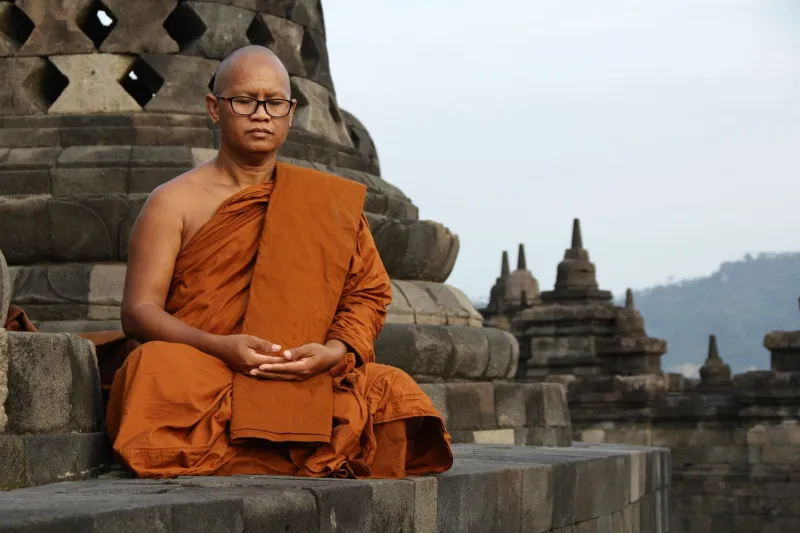
But in the quiet courtyards of Vietnamese Buddhist monasteries, a very different relationship with time has been cultivated for centuries. Monks do not fill every waking moment with structured activity. They sweep floors slowly. They sit in silence without an agenda. They allow the mind to wander without guilt or correction. This is not laziness. It is, according to both ancient tradition and a growing body of neuroscience research, one of the most sophisticated things a human brain can do.
The Problem with Optimizing Everything
Silicon Valley has exported its obsession with optimization far beyond the tech sector. Students today are told to track their sleep cycles, gamify their flashcard sessions, and schedule "recovery time" as though rest were just another productivity metric to be managed. Even meditation has been repackaged as a performance tool—something you do for twenty minutes to improve your focus scores.
The result is a generation of students who are perpetually stimulated but rarely refreshed. They are busy, but not necessarily learning deeply. They consume information at extraordinary rates, yet struggle to synthesize it into genuine understanding. Something essential is being skipped in the rush from one optimized activity to the next.
That something is unstructured mental time—and the distinction between true idleness and "scheduled rest" matters enormously.
What Neuroscience Calls the Default Mode Network
When the brain is not engaged in a specific, goal-directed task, it does not simply switch off. Instead, a constellation of interconnected regions—collectively known as the default mode network, or DMN—becomes highly active. Researchers at institutions including Washington University in St. Louis and the University of British Columbia have found that the DMN is involved in some of the brain's most sophisticated operations: consolidating memories, generating creative insights, processing emotional experiences, and constructing a coherent sense of self.
In plain terms, the brain uses idle time to do its deepest work. When a student stares out a window after a difficult lecture, their hippocampus is quietly filing away the material they just encountered. When a writer takes a long, aimless walk, their prefrontal cortex is drawing unexpected connections between disparate ideas. The "aha moment" that seems to arrive from nowhere almost always arrives during a period of non-directed thought.
Critically, this process cannot be replicated by scrolling through social media or listening to a podcast. Both activities provide low-level stimulation that keeps the brain in a reactive, task-oriented mode—suppressing the very network that enables consolidation and creative synthesis. True idleness requires the absence of input, not merely the absence of effort.
What the Monastery Understands That the Study Hall Does Not
Vietnamese Buddhist monasteries have long structured daily life around this principle, even if the language used to describe it is spiritual rather than neurological. The concept of xả (roughly translated as "letting go" or "equanimity") encourages practitioners not only to release attachment to outcomes, but to periodically release the need to be productive at all. Time is not a resource to be allocated; it is a medium in which understanding naturally ripens.
Monks engage in tasks like sweeping, gardening, or walking not as productive activities, but as occasions for the mind to rest in open awareness. There is no goal to achieve, no metric to improve. The hour is not "used" for anything. It simply passes, and the mind is permitted to move as it will.
This is qualitatively different from what most Americans mean when they say they are "relaxing." Watching television, browsing the internet, or even listening to music are all forms of consumption that require the brain to process incoming stimuli. They offer relief from conscious effort, but they do not activate the default mode network in the same sustained, restorative way.
Practical Implications for American Students
For students navigating demanding academic environments—from high school AP courses to graduate seminars—the implications of this research are both counterintuitive and liberating.
Schedule genuine empty time. Not a nap, not a podcast walk, not a "mindful" journaling session. Genuine empty time means sitting quietly, perhaps outdoors, without a device or a goal, for at least fifteen to twenty minutes. It may feel uncomfortable at first. That discomfort is worth tolerating.
Resist the urge to fill transitions. The minutes between classes, the wait at a coffee shop, the commute on public transit—these are precisely the moments when the default mode network would naturally engage, if students allowed it to. Reaching for a phone in these intervals is not neutral; it actively interrupts a restorative process.
Reframe boredom as a signal, not a problem. The sensation of boredom is the mind signaling that it has capacity available. In the monastery tradition, this is a moment of opportunity, not discomfort to be resolved. Students who can tolerate boredom without immediately seeking stimulation are, in effect, training a form of cognitive resilience that pays dividends in focus and creativity.
Separate rest from recovery. Rest days from studying are valuable, but if they are filled with high-stimulation activities, they do not provide the kind of neural restoration that true idleness does. A Sunday spent watching movies is different from a Sunday that includes an hour of genuine, unscheduled quiet.
Boredom as a Learning Strategy
It would be tempting to frame this article as an argument against productivity, but that would miss the point. The Vietnamese monastic tradition does not reject discipline or structured effort. Monks study canonical texts rigorously; they maintain precise daily schedules; they take their intellectual and spiritual formation seriously. The empty hours are not a rejection of learning—they are an integral part of it.
The same logic applies to academic life. Students who build genuine idleness into their routines are not wasting time. They are creating the conditions under which real learning can consolidate, under which creative solutions can surface, and under which the sustained motivation to keep studying can be quietly renewed.
Neuroscience did not invent this insight. It simply confirmed what the monks already knew: the mind, left to its own devices and freed from the pressure to perform, will often do its best work.
In a culture that has monetized attention and gamified rest, choosing to do nothing—truly nothing—may be the most radical study strategy available to American students today. It is also, the research suggests, one of the most effective.